
News
Team USA Completes Historic Run with Fifth Straight FIBA Women’s World Cup Title
Sep
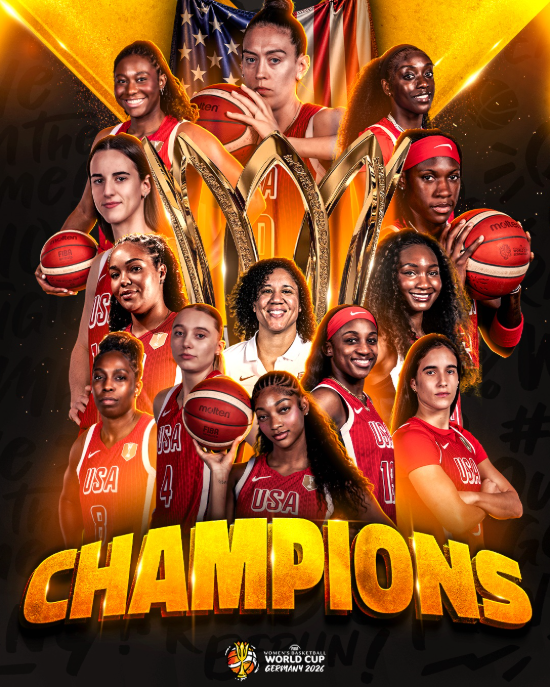
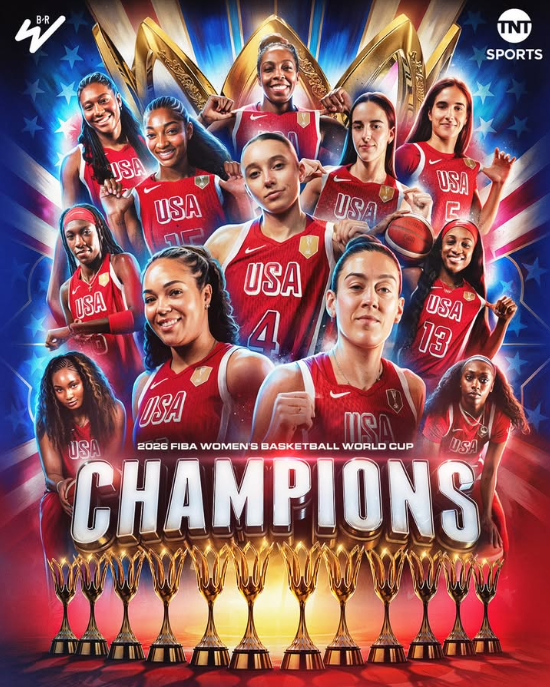
BERLIN, Germany — September 13, 2026 — The United States women’s national basketball team once again confirmed its place at the top of the international game, overcoming France 97–79 in Berlin to capture its fifth consecutive FIBA Women’s Basketball World Cup championship.
The victory delivered the United States its 12th World Cup title overall and extended an extraordinary run of dominance that has defined American women’s basketball for two decades. Team USA has now won 36 consecutive games at the FIBA Women’s World Cup, with its last defeat coming in the 2006 semifinals against Russia.
But the latest championship was far from routine.
France Puts Team USA Under Serious Pressure
France entered the championship game determined to finish the job after coming agonizingly close to international gold against the Americans at the 2024 Paris Olympics. This time, the French side gave Team USA one of its toughest challenges in years.
France opened the game aggressively and led 20–17 after the first quarter. The pressure intensified early in the second period when the French scored the first 11 points of the quarter, turning a three-point deficit into a 31–17 advantage.
At one point, the United States trailed by 14 points — its largest deficit in the tournament and its biggest challenge in a World Cup since the 2006 semifinal loss to Russia. France’s Gabby Williams and Dominique Malonga were particularly effective, combining scoring and playmaking to keep the American defense under constant pressure.
Rather than panic, however, the Americans gradually worked their way back into the game.
Breanna Stewart and Jackie Young helped stabilize the offense, while Caitlin Clark provided a crucial moment just before halftime. Clark knocked down a three-pointer at the buzzer to cut France’s lead to 45–43, giving the United States renewed momentum heading into the locker room.
“We dug ourselves a hole, but we climbed out of it, and I felt like we were never rattled by anything,” Clark said after the game.
Stewart Leads the Championship Comeback
The second half belonged to Team USA.
The Americans opened the third quarter with an 11–2 run, quickly turning the two-point halftime deficit into a 54–47 lead. Stewart played a central role in the decisive stretch, scoring four points during the early surge.
France briefly responded, cutting the deficit to 55–51, but the Americans soon delivered another decisive run. A 16–3 burst pushed Team USA’s advantage to 73–57 entering the fourth quarter, effectively putting the championship within reach. France could not recover from that separation.
Stewart finished with 22 points and 10 rebounds, once again demonstrating why she has become one of the defining figures of USA Basketball’s modern era. Jackie Young added 18 points, six rebounds and five assists, while Kahleah Copper scored 15 points and Chelsea Gray contributed 12.
Stewart’s performance earned her the FIBA Women’s World Cup MVP award, the second time she has received the honor. She previously won tournament MVP in 2018. The 2026 championship also gave Stewart her fourth World Cup gold medal, another milestone in an already remarkable international career.
“We are the standard,” Stewart said. “USA Basketball has continued to show up and go for gold.”
Clark and Boston Become World Champions
For Indiana Fever fans, the championship carried another significant storyline.
Fever stars Caitlin Clark and Aliyah Boston officially became World Cup champions as members of the U.S. national team. Both players made important contributions off the bench during the final, providing efficient offense as the Americans completed their comeback.
Clark scored 12 points in only 13 minutes, shooting 4-for-5 from the field and 2-for-3 from three-point range. She also recorded three assists, including the pivotal three-pointer at the end of the first half that helped change the game’s momentum.
Boston added seven points on a perfect 3-for-3 shooting performance, along with one rebound and one assist.
Their championship was particularly meaningful because the 2026 roster represented a new generation for USA Basketball. Clark, Boston, Angel Reese and Paige Bueckers were among the players making their first FIBA World Cup appearances, while the American roster was the second-youngest U.S. World Cup team ever assembled.
Despite the youth movement, the team benefited from the experience of established stars such as Stewart, Young, Copper, Gray and Napheesa Collier. That combination of veteran leadership and emerging talent ultimately proved decisive when the tournament became increasingly competitive.
A New Generation Joins an Established Dynasty
The path to the championship had not been as effortless as previous American campaigns.
The United States opened the tournament with a dominant victory over China, but later survived a surprisingly close 55–52 victory over Italy, the narrowest group-stage win for an American team in five decades. Team USA also defeated Spain by 10 points in the semifinals, which was the closest semifinal game during its remarkable World Cup winning streak.
The Americans entered the final having won their previous four World Cup tournaments by an average margin of 26 points in the medal rounds. The fact that France was able to build a double-digit lead illustrated how much more competitive the global women’s game has become.
Yet when the championship was on the line, Team USA produced the response expected from the world’s dominant program.
The Americans improved to 9–0 in World Cup gold-medal games since their runner-up finish in 1983, while their overall World Cup championship total reached 12.
France, meanwhile, earned the silver medal — the country’s best-ever finish at the FIBA Women’s World Cup. Malonga led France with 21 points, while Williams scored 20. The result was another painful near-miss for a French team that had already pushed the United States to the limit in the 2024 Olympic final, losing that game by only one point.
Spain defeated host nation Germany to claim the bronze medal.
The Gold Standard Continues
The 2026 championship ultimately reinforced the defining characteristic of USA Basketball: resilience.
Team USA was tested more severely in Berlin than it had been in many years. France exposed vulnerabilities, Italy pushed the Americans to the brink in group play, and Spain remained within striking distance deep into the semifinal.
But the United States consistently found answers.
Stewart provided the leadership of a veteran champion. Young delivered on both ends of the floor. Clark supplied scoring and playmaking from the bench. Boston contributed efficient interior play. And the team’s combination of experience, athleticism and depth proved too much for its opponents to overcome.
For Stewart, the message after another gold medal was simple: the standard remains unchanged.
“Our goal is always gold,” she said.
In Berlin, Team USA once again achieved exactly that — extending its unprecedented World Cup dynasty while simultaneously introducing a new generation of stars who will carry American women’s basketball into its next chapter.
The United States leaves Germany as five-time consecutive World Cup champions, 12-time world champions overall, and still the undisputed gold standard of international women’s basketball.
